Thursday, 23 June 2011

Starry Night


1889

Oil on linen

73x92 cm

Museum of Modern Art, New York, USA

I haven’t a favorite photograph. Actually I have lots Vincent Van Gogh’s favorite paints.At the time that he was in Arles, looking for a different light and a sky brighter after to found the color in Paris. Here, the artist was shocked by the blue and yellow lights of the place...

I love his painting techique which exalts the contrast of light in the imagen even in the night The same Van Gogh said once “I often think that night is more lively and richer in color than the day”. So, I choose the Starry Night because it represents his idea about the particular tones when the sun disappears.

Vincent appreciated the bright and off feeling at the same time that the night has. So, we can see that the stars and the moon seems suns over the village. Besides there is a black spot that extends to the heaven when all the space is full of light. (Here is the contrast).

Thus, the dutchman artist show us a scene witch details doesn’t matter (for example, with a few touches of yellow, Van Gogh represents lights on inside of the houses of the village) but a only space feeling.

Tuesday, 7 June 2011

The equipment of music


Now, I want to share you about my favorite piece of technology: the equipment of music. I’m in love with it for almost 10 years. I’m serious. The music is very important in my life. Practically I don’t watch tv, because usually tv shows bad music when it shows. I only watch tv for the news and some movie. But, in general, I choose turn off the tv and turn on the equipment to listen radio or to play on any cd. I like the equipment of music because it´s is not depending of a battery limited, like the mp3 or mp4. Besides, I’ve lost two mp3, but the equipment still here with me.

Every day, when I wake up, I turn on the “Sonar” Radio, 105.7 FM, though not loud, because the rest of my family is sleeping and it could be very annoying. It´s very good the music and the speakers are very nice too. I think that Alfredo Levin’s voice is too sexy, therefore it’s amazing listening him. Well, that´s personal. You can be in disagreeing.

Anyway, I have to say that music playing in my room, my own place, is cool because nobody can say to me “Hey! I’m working here, please down the volume” or “This song don’t like to me, change it!” Well, my sisters use to say things like that when I shared the room, but now, it´s different. Now I select what kind of music I want to hear. I’m free to decided and for me it´s better than any other piece of technology.

P.S: This is the image of my first equipment of music. When it failed, I took my mom’s equipment. She still is asking it.

Some exotic

Today I want to write about a new fruit that I ate two days ago. My boyfriend, Nico, gave me to taste a “Feijoa” or a “brazilian gayaba”. It´s small and the taste is similar to a kiwi: it´s very acid but sweet at the same time. I surprised when he told me that his family didn’t buy it in the supermarket, but in the “feria”. I thought that feijoas could be expensive, but they are not.

From this I wonder about others exotic foods and I remembered that some chefs are using flowers on their preparations. Yes, real flowers! From rose petals, begonias, hooded, magnolia, jasmine, orange blossom, lavender, mint, lotus, zucchini, marjoram, violets, between others, can appear in your lunch. There are flowers to drink, for example like wine or tea, and flowers to eat, like appetizers or desserts. You can use it from sushi to creams, salads, sauces, jams, jellies and even mousses.

Besides the colors, flowers give other food savors. For example, roses are bitter and begonias are acidic. Some people consider that flowers are elegant and can make of a simple food to a special food. For me, it’s something weird that flowers can be in a cake, like in this image:

What do you think? Would you eat a flower?

Erving Goffman and the social drama

An expert in my field is Erving Goffman, sociologist and writer, who was considered “father of microsociology”. He was born in 1922, in Manville died in 1982. His parents Max and Ann, were Russian who immigrated to Canada by the World War I. At first, he studied chemistry in Manitoba and later, he worked making documentary films in Ottawa on the National Film Board. Here a friend convinced him about to study Sociology at University of Toronto, where Goffman read about Durkheim, Parsons, Margaret Mead, Radcliffe-Brown, Freud...

In 1952, and after of his graduation, he got marry Angelica Schuyber, a younger sociologist who, unfortunately, committed suicide 12 years later. But in 1981 he married again, with Gillian Sankoff, a linguist. Besides, Goffman was President of American Sociological Association. Finally, Goffman dies of stomach cancer in the same year.


Goffman was very important at the Second School of Chicago, for the Symbolic Interactionism of
early twentieth century. For him, “The human behavior is like a continuous scenic representation”. All of us adapt our actions to the actions of others. We don’t talk or don’t do the same things with a friend, with a teacher, with our parents... with anyone. In everyday life, our speech and our movements depend of the context.


Language helps us to define the situations for the others and by the others. By Goffman, persons are “actors” who represent different roles every day, just like a play of theater. But actions of each one in front of society, also, have many things hidden, which Goffman called “the backstage of actor”. Besides, we control the information to the others and we try to get the most information possible from these others. People show to others only what they want to and not the complete reality. According this, men and women use “masks” by the situation which can be make up, kind of clothes, the race or the sex, appearance, the voice, the way you move and so on.

I think that his work is interesting, because while other sociologists were interested in big groups or even all the society, Goffman studied minimum units of interaction between persons.

If you liked the Goffman’s theory I suggest you to read:

  • The Presentation of Self in Everyday Life (1959)
  • Encounters: Two Studies in the Sociology of Interaction (1961)
  • Stigma: Notes on the Management of Spoiled Identity (1963)

Friday, 6 May 2011

More fun for our Faculty


Hi everybody! Today I’m going to write about the fun. In the presentations of today I realized that the one topic that wasn’t rigorsly academic was the videogame by Bea. And I though…Why are we so serious? I know that at University, like a formal place, it’s necesary to have a correct expression in the language in the clases. But, Won’t we be too serious in the majority of things? I’m not saying that religión, gender or another themes aren’t important. Of course not. I mean that it seems that racionality is dominant in almost everything. I wonder… Why in this Faculty are not things more fun? Our activities are studying (of course), going to congress or a conferences of “important topics by important people” and we keep studying at home. And althought, yo can see tv or going out with yor friends or your boyfriend/girlfriend, I think that the Faculty should be more fun simetimes, because many of us are here almost all the day … Maybe you think that study in fun, but I believe that is necesary to have another activities that can relax us and distract from the stress of de carrer.

I was thing, especially, in a “pillow war” or in a evening of movies. Yes, here in the Faculty. Don’t you like to do something more entertaining with your friends and classmates? And if the teachers want it too, that wasn’t a problem (at least for me) Do you have other ideas for enjoying and having a good time in this builing?

Friday, 8 April 2011

Social contact


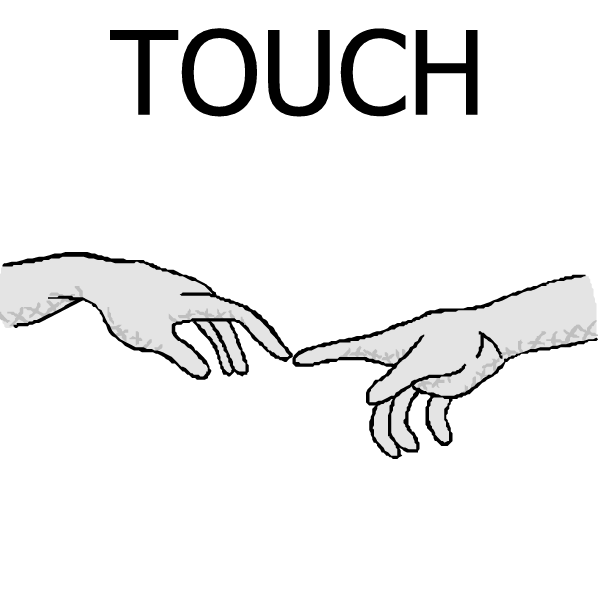
Well, like my blogs is about "things", this time I'll write about the contact that the people have in the daily life and in specific, how human relations are colder each time . First, when I'm talking about contact I mean the interaction between two or more persons in any situation. Maybe in the subway, in the street, in a park... These contacts can be eventual or permanent, but what they have in common is the distance in people's relations. Maybe one can think in the “racionality” that envolved all the aspects of the our lives. Not only jobs or business of the capitalist system, but the way that we look to the other is rationalized too. How can we explain that we are next to other and we tray to have the less contact possible with them? I think it’s very clear at peak time in the subway, the people don’t want to be closer to each other and the try to protect themselves and their things because they believe that “the other” can be dangerous. Nowadays, people reject being the nearby. Besides, when someone has an unexpected behaviour with us, like a hug or a smile, including a kiss we surprise too much!! So, I invite you to write here another situations that you had have that show us how the people are further and furher.

Friday, 1 April 2011

Hi!

Hi!